 In February 2026, Italy once again hosted the Olympic Winter Games, officially earning its status as a two-time Olympic Winter Games host. Nearly seventy years after Cortina D’Ampezzo hosted the Games in 1956, the region returned to the Olympic stage. However, this time, Cortina entered the Games in partnership with Milan, the co-host for the 2026 Olympic Winter Games. These Games featured 93 national teams competing across 16 sports and 116 events, drawing athletes from all over the world, including the United States.
Throughout the Games, the United States rallied behind Team USA, following an Olympic journey marked by emotional highs and defining moments on the ice. In men’s hockey, Team USA ended a 46-year gold-medal drought when Jack Hughes scored the “golden goal” just 1 minute and 41 seconds into overtime, securing the nation’s first Olympic gold medal in the event since the legendary “Miracle on Ice” victory in Lake Placid in 1980.
As the Games came to a close, a range of artifacts and materials from Milano Cortina 2026 entered the Museum’s collection, preserving the legacy of these Games for future interpretation and research.
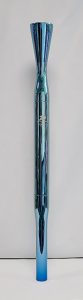
The Olympic Torch
For the 2026 Winter Games, the Olympic torch reimagines tradition by dematerializing the torch and elevating the flame. Designed to let the fire take center stage, the torch minimizes its physical presence while amplifying the flame through a refined, high-tech design.
Created by Carlo Ratti Associati in collaboration with Eni and Versalis, with engineering by Cavagna Group, the torch emphasizes innovation and sustainability, featuring a reusable form made from recycled materials and powered by renewable gas, so the flame itself can truly shine.
On February 6, 2026, Italian alpine skiing legends Alberto Tomba and Deborah Compagnoni served as the final torchbearers in Milan, where they jointly lit the Olympic Cauldron at the Arco della Pace. At the same moment, Sofia Goggia lit the second Olympic Cauldron in Cortina d’Ampezzo at Piazza Dibona. This dual lighting marked the first time in Olympic history that two cauldrons were ignited simultaneously, symbolizing the shared hosting of the Games between Milano and Cortina d’Ampezzo.
The Olympic Medals
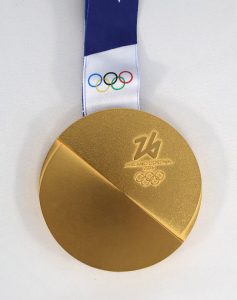
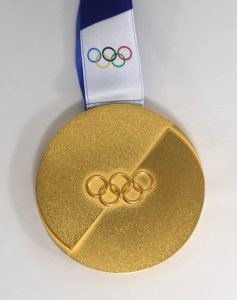
The prize medals for the 2026 Olympic Winter Games in Milano Cortina feature a minimalist yet deeply symbolic design that highlights emotion, unity, and teamwork. Reflecting the connection between Milano and Cortina, the medals are composed of two halves brought together, mirroring the values of the Olympic and Paralympic movements.
This duality represents not only the journey of athletes and Para athletes but also the collective effort of everyone who supported them. The design serves as a powerful metaphor for two worlds becoming one, celebrating a global spirit where competition unites rather than divides.
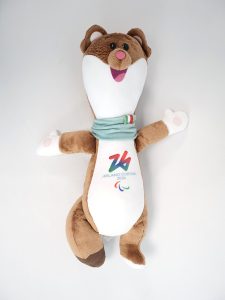
The Olympic & Paralympic Mascots
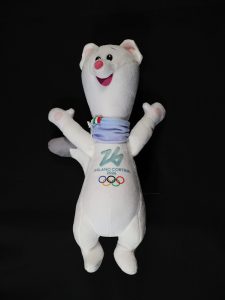
Meet Tina and Milo, the official mascots of the 2026 Milano Cortina Olympic & Paralympic Games. These spirited stoat siblings were chosen from over 1,600 student submissions in a nationwide contest. Tina’s name comes from the host city of Cortina and is the Olympic mascot. Born in the Italian mountains, she is very close with her brother Milo. She loves innovation, dreams of changing the world, and does everything she can to protect nature. Milo’s name comes from the host city of Milano, and is the Paralympic mascot. Living in the mountains, he loves building artifacts and exploring nature. Born without a leg, he has learned to use his tail to walk and to look at obstacles as super trampolines.
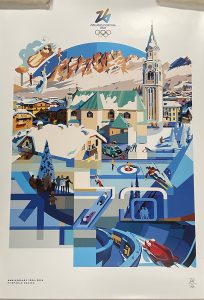 Official Poster “Anniversary 1956-2026” Poster
Created to mark the 70th anniversary of Cortina d’Ampezzo’s first hosting of the Olympic Winter Games, the “Anniversary 1956–2026” poster by Italian artist Pierpaolo Rovero constructs a visual dialogue between past, present, and future. The composition references Cortina’s Olympic heritage through archival imagery and tribute, including skier Eugenio Monti, while centering the enduring symbolism of the town itself. It then projects forward to Milano Cortina in 2026, highlighting the sports set to return to Cortina, including bobsleigh, luge, skeleton, women’s alpine skiing, and curling. Through this layered design, the poster reflects both continuity and evolution within the Olympic movement, connecting historical memory with the contemporary identity of the Games.
Olympic Pins
Pin collecting remains one of the most visible and enduring traditions of the Olympic Games, and continued on during the 2026 Winter Games. Pins served not only as souvenirs but also as informal symbols of identity, representing teams, sports, venues, and host communities. Reflecting this tradition, the Museum’s collection includes a selection of pins donated by Team USA luge athlete Zach DiGregorio, further strengthening the local connection to the 2026 Games. These contributions offer a personal dimension to the broader culture of Olympic memorabilia and feature the ongoing role of athletes in shaping the material record of the Games.
The 2026 Milano Cortina Olympic Winter Games continue the long tradition of the Olympic Movement while adding a distinct and contemporary chapter to its history. Through the acquisition of key artifacts, including ceremonial objects, commemorative designs, and athlete-donated materials, the Lake Placid Olympic Museum preserves the history of these Games for future interpretation. Together, these items not only highlight athletic achievement and host-nation identity but also ensure that the stories of these Games remain accessible as part of the evolving legacy of Olympic winter sport.
Curator’s Corner written by Julia Herman