One of my favorite things inside the Museum is our poster wall. Full of bright colors and fun designs, I always enjoy pausing to find new details in the artwork. Each one is unique, and official posters often include elements that can be decoded by learning more about that country’s culture or understanding what was going on in the world at the time of those Olympics.
Reading A Century of Olympic Posters by Margaret Timmers gave me new insights, teaching me more about the wall I admire every day. This book chronicles the evolution of art and design in Olympic Summer and Winter posters from 1896 to 2012.
What particularly interested me about this book were the connections the author made between design elements and global events. For example, the 1948 St. Moritz poster sought to emphasize coming out of the darkness and heading into a bright, hopeful future. They did this as the countries of the world gathered for the first time in over a decade for nonviolent reasons, seeking to leave behind the tragedy of the Holocaust and World War II. The poster was also repurposed as a travel poster, helping to revitalize Europe’s postwar economy.
In 1972, the Munich design team initiated the use of pictograms for a more accessible communication model, a strategy still used today. Designers realized that art was a common human language that many people could understand, thus accommodating the diverse array of linguistic backgrounds found at the Olympics.
I learned that the 1988 Calgary poster created its central snowflake design using the letter ‘C’ over and over—with big ‘C’ for Canada and little ‘c’ for Calgary. Furthermore, I never noticed that the snowflake is not a snowflake at all! While snowflakes always have six points, this one has only five. Instead, designers used the maple leaf from the Canadian flag, representing national pride.
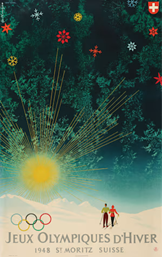
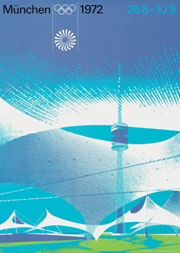
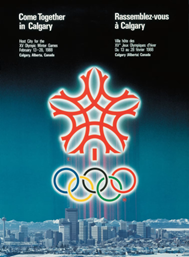
Images from olympics.com
Lastly, I found out some history behind my favorite poster. The 1994 Lillehammer poster, with small pictograms of people playing different winter sports, was inspired by ancient Norwegian rock art from the north of the country.
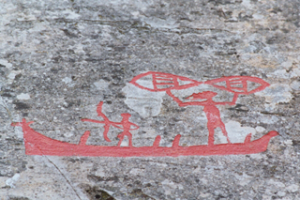
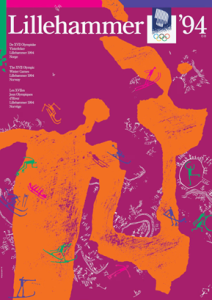
Images from L-R: UNESCO and olympics.com
A Century of Olympic Posters is an interesting read with plenty of visual artwork. Not only do the posters reveal Olympic history, but they also provide snapshots of world history. They share human hopes, cultural pride, and the versions of ourselves we have sought to present to the world.
Written by Bridey Ryan