The Lake Placid Olympic Museum proudly showcases the Olympic torches, one of its most popular displays. Featuring 14 different torches, this exhibit highlights their unique and symbolic designs while detailing the history of the torch relay. This past spring, we received a donation of the 2002 Salt Lake City torch. This artifact enhances our ability to tell the story of this remarkable Olympic tradition and provides visitors with an up-close experience of an important piece of Olympic history.
Torch Relay History
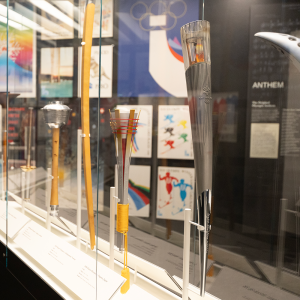 The lighting of the Olympic torch and the subsequent torch relay serve as the official announcement of the Olympic Games, symbolizing peace and friendship. The first torch relay was held at the 1936 Summer Games in Berlin, Germany, and the first Winter Games torch relay took place in 1952 in Oslo, Norway.
For every Olympiad, a flame is lit at Olympia, Greece, home of the ancient Games. The flame then embarks on a global journey from Greece to the host city of the modern Games. Until that flame arrives, anticipation and excitement for the Games build up around the world.
The flame unites the runners as it passes from hand to hand, each relay participant carrying their own torch. Traditionally, torch relays take place on foot. As the Olympic Games spread throughout the world, the flame has traveled by plane, where it is sheltered in a security lamp similar to a miner’s lantern. Some other creative means of transport include skiers, dog sleds, swimmers, horses, camels, canoes, steamboats, trains, parachutes, and satellites. Amazingly, astronauts carry torches into space in advance of the Summer Olympic Games in Atlanta 1996 and Sydney 2000, as well as the Sochi 2014 Olympic Winter Games.
Each torch represents the host country’s culture and history in a unique way, making it a fascinating aspect of the Games. The torches’ diverse designs reflect each host country’s cultural heritage, adding a special touch to the Olympic torch relay.
The 2002 Salt Lake City Olympic Torch Relay
In 2002, the torch relay returned to the United States for the Salt Lake City Winter Olympic Games. Torchbearers in this relay were chosen from more than 300,000 submissions. Americans were invited to submit the name of a person who was a source of inspiration in their lives. The final torchbearers were the US Men’s Ice Hockey team members from the 1980 Lake Placid Winter Games—also known as the winners of the “Miracle On Ice.”
The relay traveled approximately 13,500 miles, visiting locations nationwide that have previously hosted the Olympics. Throughout, 12,012 torchbearers worked together to transport the flame to its final destination. The journey began on November 19, 2001, and ended on February 8, 2002, at the Opening Ceremonies of the XIX Winter Olympic Games.
Welcoming Another 2002 Torch to Our Collection
In May 2024, our collections staff received a donation inquiry that would include several items from the 2002 Salt Lake City Torch Relay: a 2002 torch, a complete torchbearer uniform, and a certificate of recognition for the relay. Upon further discussion with the donor, museum staff learned that these items belonged to Marylou Whitney, an American socialite and philanthropist from Saratoga Springs, NY. Born on Christmas Eve in 1925 in Kansas City, MO, she became immersed in the horse racing world in Saratoga Springs with impressive
results. One of Marylou’s horses, Bird Town, won the 2003 Kentucky Oaks at Churchill Downs in a record time and a victory in the Acorn Stakes at Belmont Park. In 2004, another one of her horses, Birdstone, won the Belmont Stakes and the Travers Stakes at Saratoga Race Course. To read more about Whitney’s inspiring legacy, please follow this link: https://www.racingmuseum.org/hall-of-fame/pillar/marylou-whitney.
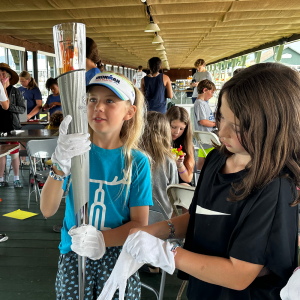
Since receiving Marylou’s 2002 torch, we have used it in our “Touch-a-Torch” program. Twice a week, visitors are invited to experience history by holding an authentic Olympic torch. Knowing the history behind this Salt Lake City torch allows us to share more detailed information with our visitors. With the other torches in our collection, we don’t always know who carried each one, but now we can provide a meaningful anecdote about this artifact that connects back to an important part of New York State history. We now have two torches to bring out to the public on a rotating basis: the 1980 Lake Placid Torch and the 2002 Salt Lake City Torch. We are excited to share this new addition with visitors and hope to see you all at the Museum!
Written by Julia Herman and Bridey Ryan